
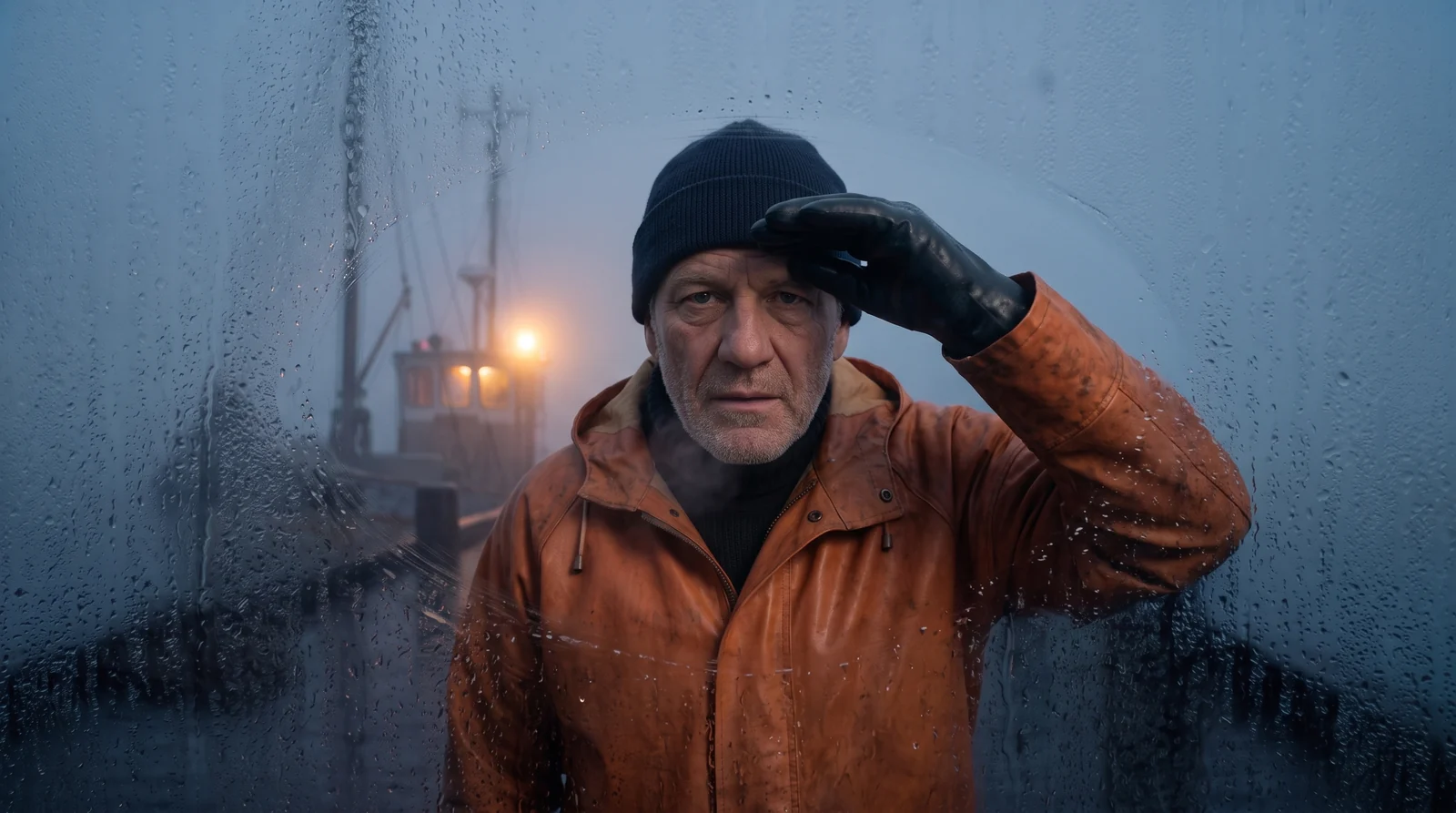
В этом гайде показываю по шагам, как сделать рекламу для ресторана с помощью ИИ: рекламный ролик на 25 секунд для экранов в зале. Сначала в нейросети делаю раскадровку, потом листы персонажей, локацию, рыбу, лист ящика, стекло и руку с тремя пальцами, в конце само видео и музыку к нему. Понадобятся идея и нейросети: Nano Banana 2.1 для картинок, Seedance 2.5 для видео и Suno для музыки. Все промты готовые: их можно скопировать и подставить своих персонажей и свой товар.
Задача и идея
Сначала я формулирую задачу рекламы и идею, которая её решает. От них зависит всё остальное: раскадровка, ассеты и промт видео.
Задача. Показать свежесть продуктов рыбного ресторана. Сделать рекламу для трансляции на телевизоре в зале.
Идея. Из этой задачи родилась идея: экран в зале ресторана работает как окно на причал. По ту сторону запотевшего стекла стоит рыбак: он протирает стекло ладонью, вглядывается в зал, считает гостей и показывает число на пальцах. Потом он снимает со штабеля ящик и отдаёт его официанту. Официант несёт ящик на камеру, и в последнем кадре видно, что в нём лежит: три палтуса на льду. Смысл рекламы: рыбу ловят для тех, кто сейчас в зале.
Формат. Видео идёт на телевизоре в зале, и из этого следует формат. Кадр 16:9, под экран телевизора. Действие идёт одним непрерывным дублем на 25 секунд, без склеек: зритель смотрит на причал как в окно. Всё действие идёт на причале: в ресторане гость и так сидит. Слов в видео нет, звук — шумы причала и музыка.
Настройки картинок. Все ассеты я делаю в одной модели: формат 16:9, разрешение 2K. У раскадровки формат 21:9.
Шаг 1. Раскадровка
Раскадровка — кадры будущего видео по порядку на одной картинке: одиннадцать кадров с номерами. По ней я проверяю ход действия и движение камеры до того, как делать ассеты.
Раскадровку я делаю по одному промту, без референсов. Первый абзац промта описывает сам лист: сколько кадров, как они разложены и где стоят номера. Дальше коротко названы место, рыбак, официант и ящик. Потом идут кадры по номерам. Перед каждой группой кадров сказано, как снимает камера: первые пять кадров сняты одной неподвижной камерой за стеклом, остальные шесть — одно непрерывное движение камеры по причалу.
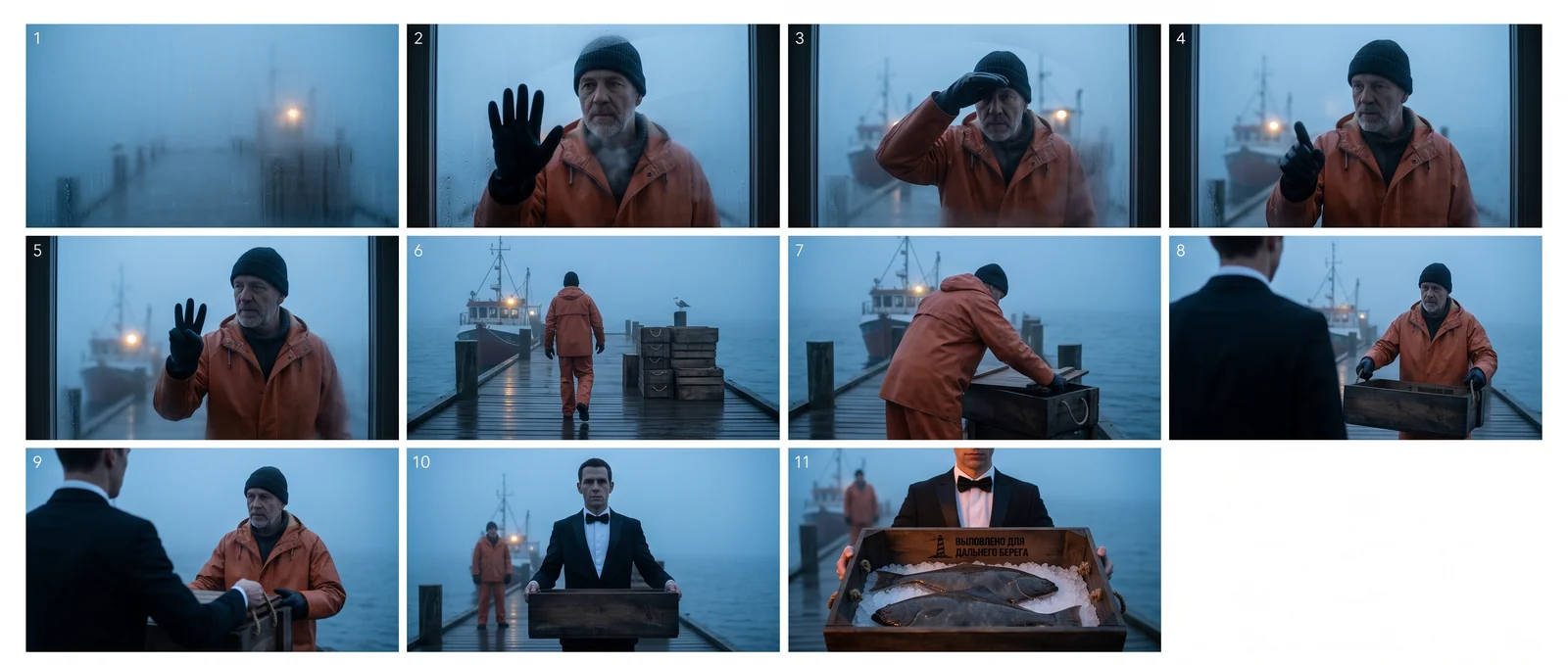
A film storyboard sheet for a 25-second restaurant commercial. One wide image. Eleven photorealistic film stills, each still 16:9, arranged in a neat grid, four stills in a row, separated by thin white gutters. In the top-left corner of every still there is a small white number, 1 to 11, in reading order: left to right, top to bottom. If one cell of the grid is left over, leave it blank white. No captions, no other text on the sheet.

The look: a modern realistic feature film, natural light, real skin, real wet textures.

THE PLACE. A fishing pier before dawn, blue hour, thick fog over a cold grey sea. Wet wooden planks, a small fishing boat moored a few steps away with one warm lamp glowing in its wheelhouse, a gull on a post, a stack of wooden crates beside the boat. No signs, no place names.

THE FISHERMAN. A weathered man of about 55 with grey stubble and a dark knitted cap, an orange oilskin jacket and orange oilskin trousers, black rubber fisherman's gloves. His breath steams in the cold.

THE WAITER. A slim man of about 30 with short dark hair, in a black tuxedo with satin lapels, a white shirt and a black bow tie, black trousers, polished shoes. The same tuxedo in every still where he appears.

THE CRATE. A wooden fish crate of planks darkened by water, with rope handles and a loose wooden lid, filled with crushed ice. Burnt into the inner side of one long board: a small lighthouse and the capital Cyrillic words ВЫЛОВЛЕНО ДЛЯ ДАЛЬНЕГО БЕРЕГА.

STILLS 1 TO 5: ONE LOCKED CAMERA BEHIND GLASS. These five stills are taken by one locked camera from exactly the same spot. The camera is inside a warm room and looks out through a window pane onto the pier. The outer side of the pane is covered with sea drizzle and salt haze. The fisherman stands outside and clears the pane from his side. In stills 2 to 5 the middle of the pane is clear and its edges stay hazy with droplets. The glass fills the whole frame from edge to edge: no window frame, no mullions, no wall are visible in any still.

1. The whole frame is blue-grey haze: the pane is completely covered with drizzle and droplets. Nothing can be seen through it except one soft warm glow far away.
2. The fisherman wipes the pane from outside: his gloved palm is pressed flat against the outer surface of the glass, seen through the glass, in the middle of a wiping stroke. Behind his palm a clear streak has opened across the hazy glass; through the streak part of his face and his orange jacket.
3. The middle of the pane is clear, the edges hazy. The fisherman shades his eyes with his gloved palm like a visor, his face close to the glass, peering into the room at us. Behind him the pier in fog and the boat with its lamp.
4. Same framing. He counts the people in the room: his index finger is raised near the glass and points past the camera, his eyes follow the finger.
5. Same framing. He has stepped one step back and holds up one hand with exactly three fingers raised: the index, middle and ring fingers; the thumb holds the little finger down. He nods.

STILLS 6 TO 11: ONE CONTINUOUS MOVING SHOT ON THE PIER. The camera has passed forward through the glass. There is no glass, no droplets and no haze in front of the lens any more.

6. The fisherman has turned his back to us and walks along the wet planks towards the stack of crates by the boat. The camera follows a few steps behind him.
7. Seen from behind: the fisherman bends over one crate and lifts off its wooden lid. We cannot see inside the crate from here.
8. The fisherman has lifted the crate by its rope handles and is turning to face the camera. The camera has pulled back: in the near foreground on the left, large and out of focus, the shoulder and the back of the head of the waiter in his black tuxedo have entered the frame. We are looking over the waiter's shoulder.
9. Over the waiter's shoulder: the handover. The waiter has taken the crate with both hands by its rope handles; the fisherman is letting go of it. The fisherman's face is turned to the waiter. From this height we do not see inside the crate.
10. The waiter has turned around and walks towards the camera with the crate, holding it level at waist height with both hands, arms slightly bent. His face is visible, calm. The camera is at the height of his chest, so the inside of the crate is not visible yet: we see only its front board. Behind him the fisherman has stayed by his stack of crates near the boat and watches him go; the boat with its lamp, the fog. The light is cold and blue.
11. The same moment a few steps later. The waiter's pose is exactly the same as in still 10: he walks, holds the crate level at waist height with both hands, does not tilt it and does not show it to us. Only the camera and the light have changed. The camera moves backwards in front of him, has risen a little and pushed in, so now we look down into the crate: it fills the lower two thirds of the frame. On crushed ice lie exactly three whole halibut side by side, three fish, flat, dark olive-brown. On the inner side of the far board, facing us, the burnt-in lighthouse and the words ВЫЛОВЛЕНО ДЛЯ ДАЛЬНЕГО БЕРЕГА. Behind the crate, close: the waiter's chest, white shirt, black bow tie, satin lapels; his face is cropped out above the chin. Behind him it is still the cold blue pier in fog, out of focus, with the small orange figure of the fisherman by his crates and the lamp of the boat. From the front, from behind the camera, warm amber light has begun to fall on him: it warms his shirt front, his hands, the wood of the crate, the ice and the fish, while his shoulders keep a cold blue rim from behind. No restaurant, no room, no lamps and no tables are visible anywhere: the place he is walking into is shown only by the colour of the light.
С раскадровки я беру порядок кадров и движение камеры: по ним в шаге 9 расписано действие по времени. Вид рыбака, официанта, причала и ящика задают ассеты из следующих шагов.
Шаг 2. Лист рыбака
Лист персонажа — четыре вида одного человека на одной картинке: крупный портрет и фигура в полный рост спереди, в три четверти и со спины. С него видеомодель берёт лицо, телосложение и одежду.
Рыбака я делаю по одному промту, без референсов. В промте три абзаца: раскладка листа, внешность с одеждой и поза. Одежду я описываю целиком, от шапки до сапог и перчаток: в видео рыбак протирает стекло ладонью и показывает число на пальцах, поэтому перчатки названы уже на листе. Штормовка оранжевая: в начале видео рыбак виден сквозь запотевшее стекло только оранжевым пятном.
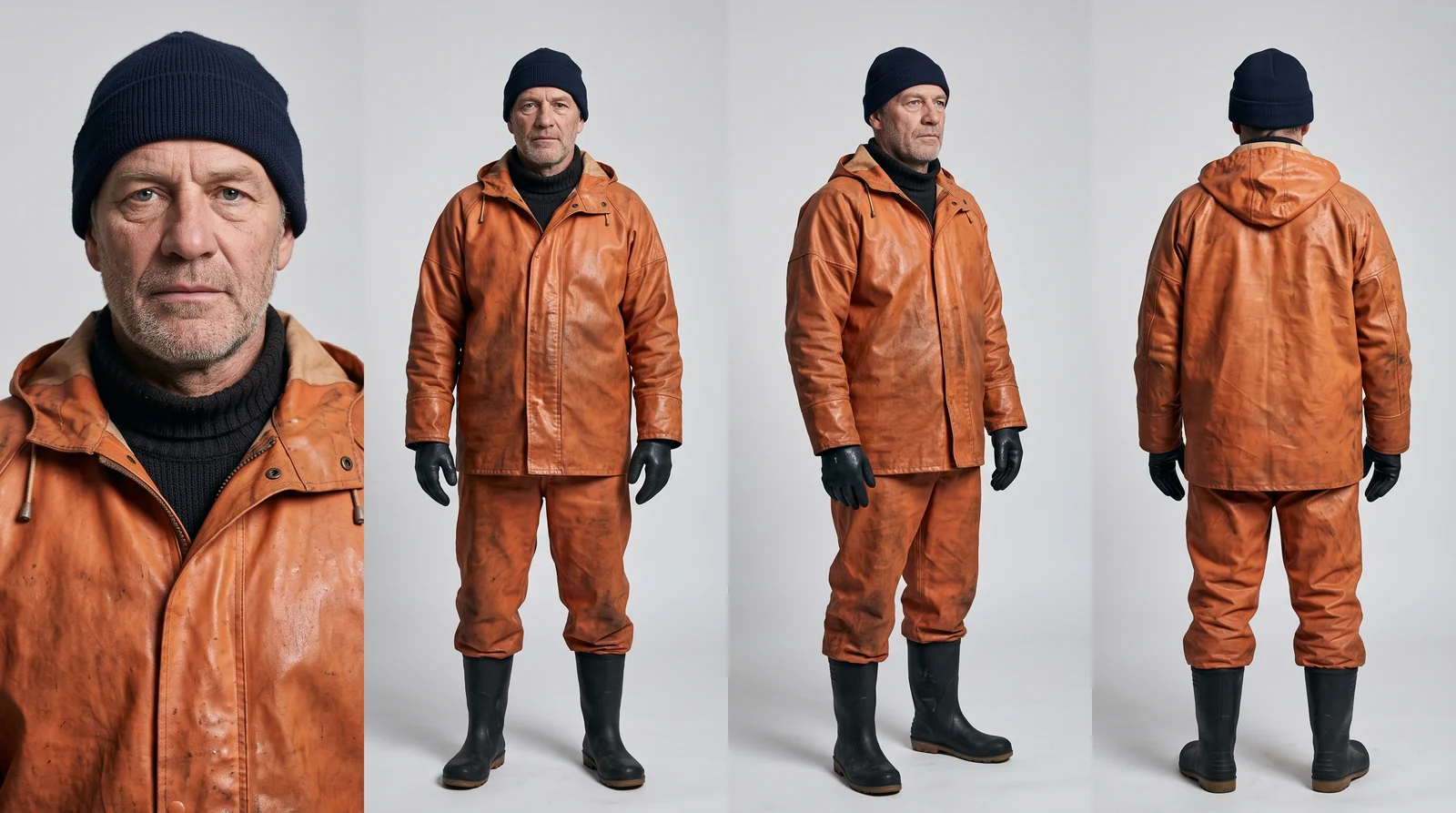
Photorealistic character reference sheet on a plain light-grey studio backdrop, soft even light, no shadows on the backdrop. One and the same man shown four times at the same scale, in a row: a close-up portrait facing the camera; full body from the front; full body in three-quarter view; full body from the back.

The man: about 55, weathered, deep lines around grey-blue eyes, short grey stubble, a broad nose, a calm closed mouth. A dark navy knitted cap pulled down to the eyebrows. An orange oilskin jacket with the hood down over a dark wool roll-neck sweater, orange oilskin trousers, black rubber boots, black rubber fisherman's gloves. The oilskin is worn and wet, with creases at the elbows.

He stands straight and relaxed, arms down, looking into the lens. Real skin with pores and small marks, no retouching. Same face, same clothes and same proportions in all four views. No text, no labels.
На готовом листе я проверяю, что во всех четырёх видах один и тот же человек в одной и той же одежде.
Шаг 3. Лист официанта
Второй персонаж — официант. Его лист устроен так же: крупный портрет и три вида в полный рост.
Первый абзац промта тот же, что у рыбака: он задаёт раскладку листа. Меняется абзац о человеке: возраст, лицо, причёска и одежда. Официант в чёрном смокинге с белой рубашкой и бабочкой. В промте сказано, что руки у него без перчаток: в видео он берёт ящик голыми руками.
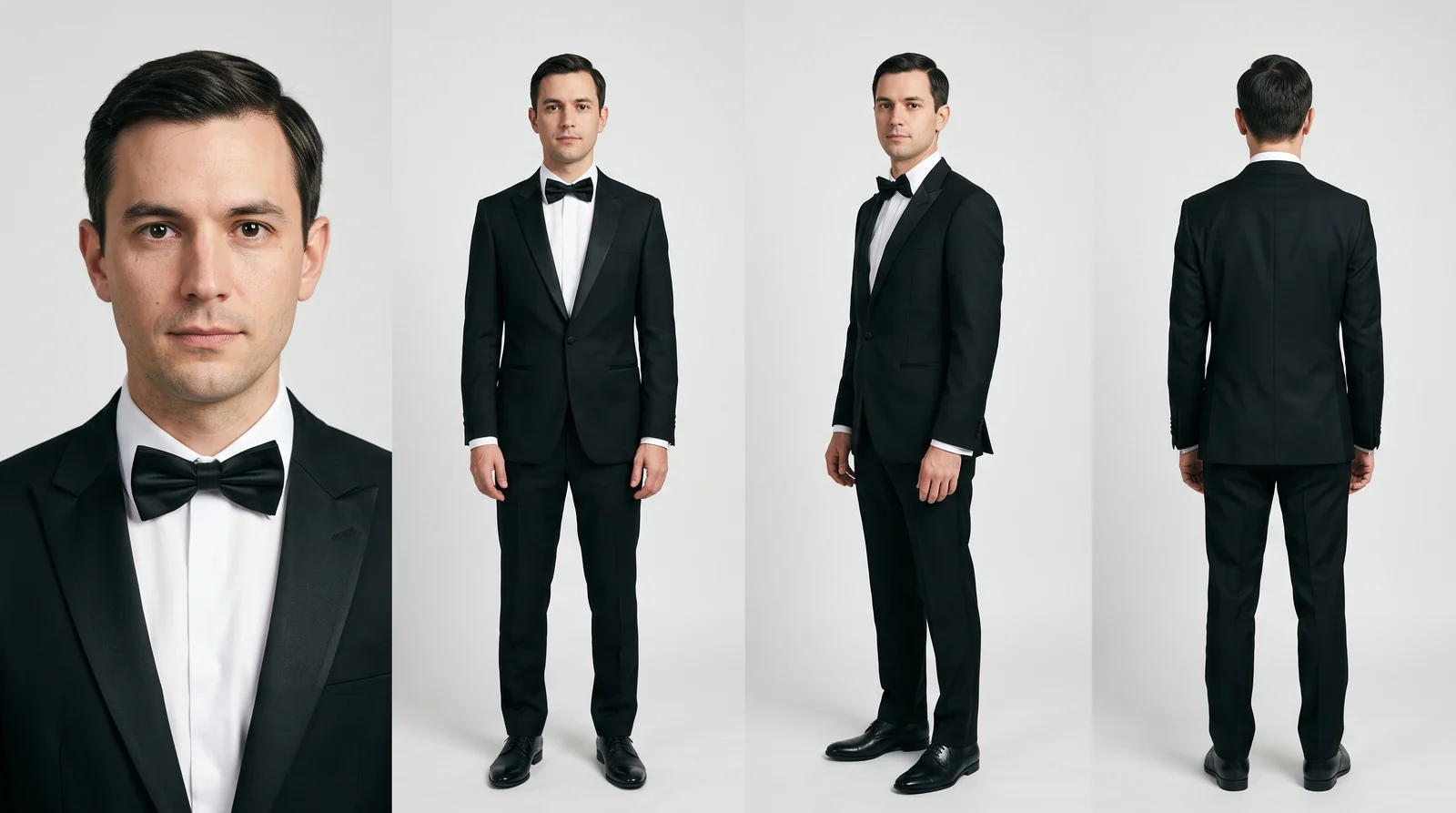
Photorealistic character reference sheet on a plain light-grey studio backdrop, soft even light, no shadows on the backdrop. One and the same man shown four times at the same scale, in a row: a close-up portrait facing the camera; full body from the front; full body in three-quarter view; full body from the back.

The man: about 30, slim, clean-shaven, short dark hair neatly combed to the side, dark eyes, a calm attentive face, mouth closed. A black tuxedo with satin peak lapels, a white dress shirt, a black bow tie, black trousers, polished black shoes. Bare hands.

He stands straight, arms down, looking into the lens. Real skin with pores, no retouching. Same face, same clothes and same proportions in all four views. No text, no labels.
Шаг 4. Локация
Локация — рыбацкий причал в тумане перед рассветом, без людей. С неё видеомодель берёт причал, лодку с лампой, сваи, туман и свет.
Локацию я делаю в два приёма. Сначала причал по одному промту, без референсов. Камера стоит в начале причала и смотрит вдоль него: так же построен кадр в видео. Тёплый свет в кадре один — лампа на рубке лодки, всё остальное холодное и синее. По этому промту у лодки стоит штабель ящиков: с него я беру ящик для листа в шаге 6.
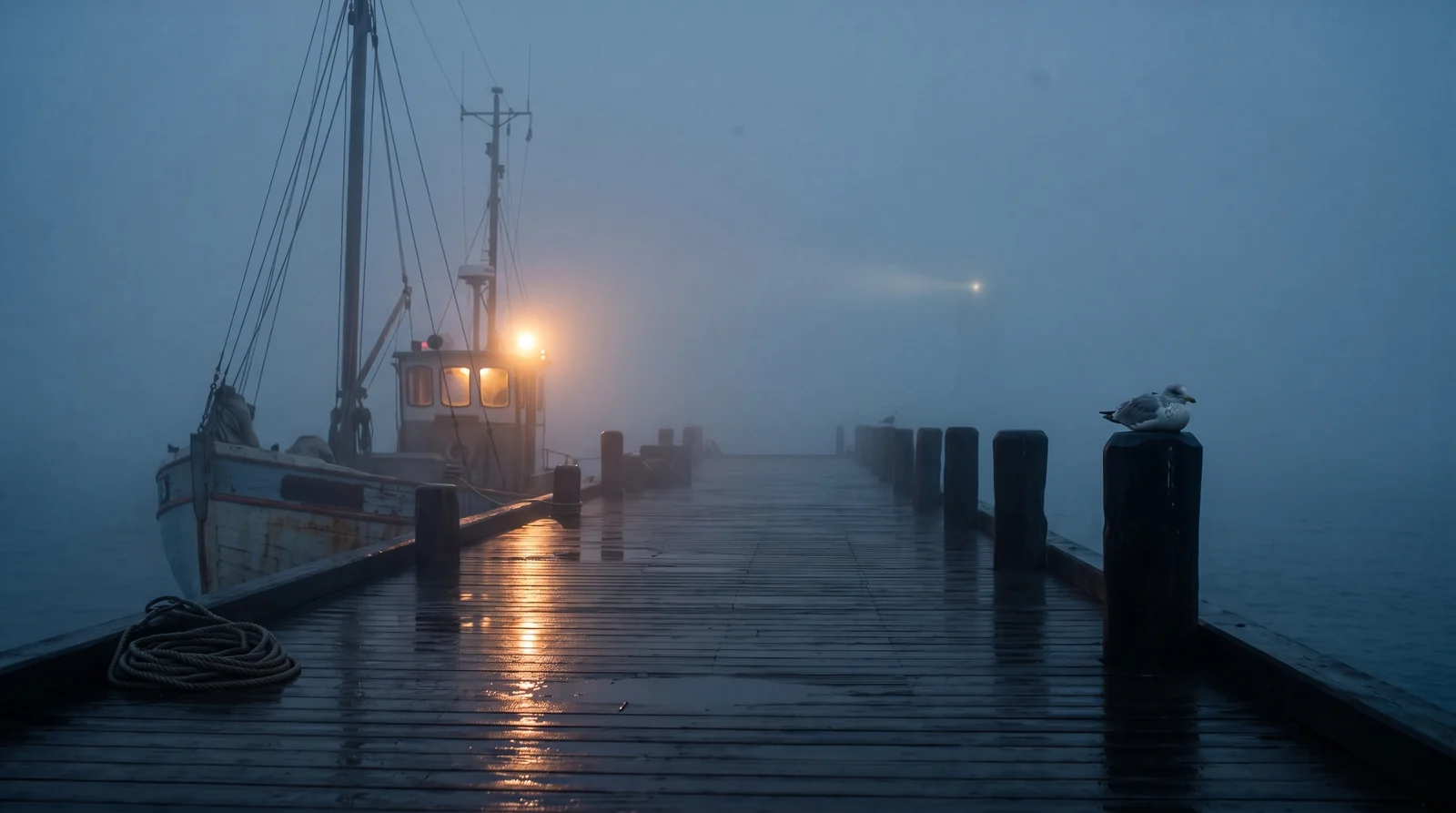
A frame from a feature film shot on a large-format cinema camera with a 28 mm lens, 16:9. A fishing pier in dense fog before dawn, almost night. No people.

The camera stands at chest height at the land end of a dark wooden pier. Everything beyond ten metres dissolves into blue-grey fog. The wet planks gleam; in the puddles lie stretched reflections of warm light.

On the left, close, a fishing boat is moored, half swallowed by the fog: only its wheelhouse is clear, with one strong warm lamp behind the glass that throws a wide soft halo into the mist and a long amber path across the wet planks towards the camera. The mast and rigging fade upwards into the fog. Beside the boat on the pier a stack of dark wooden fish crates with rope handles, glistening with water, and a coiled rope.

On the right, mooring posts march away into the fog and disappear; on the nearest one a gull, fluffed up against the cold. Somewhere very far off a lighthouse beam passes through the fog as a faint moving glow. The sea is barely visible: a dark flat surface that merges with the fog.

One warm light against a world of deep cold blue. Heavy, quiet atmosphere, visible moisture in the air, soft film grain, natural contrast. No signs, no text, no place names.
Потом я убираю ящики правкой: с локации видеомодель берёт всё, что на ней есть, а где стоит штабель и сколько в нём ящиков, сказано в промте видео. Картинку причала загружаю референсом и пишу в промте, что убрать, что видно там, где стоял штабель, и что остаётся без изменений.
Edit image 1. Remove the stack of crates on the left of the pier completely, together with the fishing net hanging on it. Where the stack stood, show the empty wet planks of the pier and the side of the boat behind, continuing naturally, with the same light and reflections. Keep the coil of rope on the planks. Keep everything else unchanged: the boat, the lamp, the planks, the reflections, the posts, the gull, the fog, the framing. No crates anywhere, no people, no text.
Шаг 5. Рыба
Рыба — отдельный ассет: фотография одного палтуса на колотом льду, снятая сверху. С неё видеомодель берёт кожу, форму и влажный блеск рыбы.
Рыбу я делаю по одному промту, без референсов. В промте названа рыба — тихоокеанский палтус — и описано её строение: плоское ромбовидное тело, оба глаза на верхней стороне головы, длинные плавники вдоль обоих краёв. Кожа описана подробно: матовая, оливково-коричневая, с пятнами, каплями талой воды и мелкими потёртостями. Там же сказано, какой она быть не должна: глянцевой, лакированной, пластиковой. Эта же картинка идёт референсом в лист ящика в шаге 6.
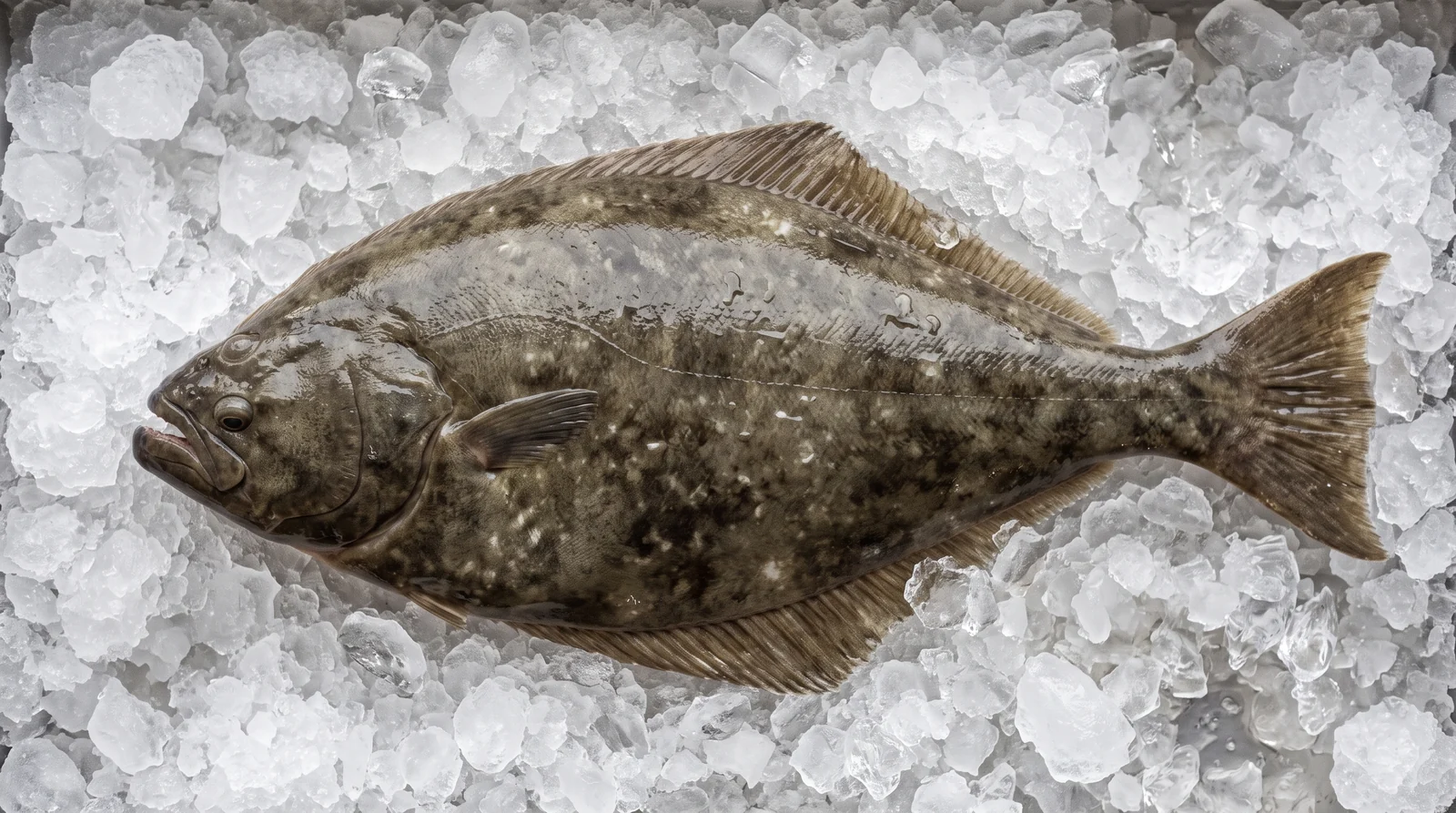
Documentary photograph of one whole fresh Pacific halibut lying on crushed ice, shot straight from above. A real flatfish: a flat diamond-shaped body about 50 cm long, both eyes on the upper side of the head, close together; a large closed mouth; the long dorsal and anal fins run along both edges of the body; a slightly concave tail. The upper side is matte olive-brown to grey-brown with irregular darker and paler mottling, fine small scales, a visible curved lateral line above the pectoral fin; a thin wet film of natural slime, a few drops of melt water, small scuffs and imperfections. Not glossy, not varnished, not plastic, not golden. Head to the left, tail to the right. Crushed half-melted ice, cloudy and clear pieces, around and under the fish. Soft overcast daylight from a window, neutral colour, no warm tint. Shot on a full-frame camera with a 50 mm lens at f/5.6, sharp from head to tail, natural colour, a fish market still life. No hands, no people, no text, no labels.
Шаг 6. Лист ящика
Лист ящика — один и тот же ящик с рыбой в четырёх видах на одной картинке: в три четверти, сверху, сбоку и с торца. С него видеомодель берёт форму ящика, тёмные рейки, верёвочные ручки, лёд и трёх рыб.
Лист я собираю в три приёма. Сначала сам ящик: я беру его с причала из шага 4, с картинки до правки, где у лодки стоит штабель. Референсов два: эта картинка и увеличенный фрагмент со штабелем, вырезанный из неё. В промте сказано, что это один ящик из штабеля, и его устройство названо словами: три рейки в высоту на каждой стенке, по одной верёвочной ручке на торцах.
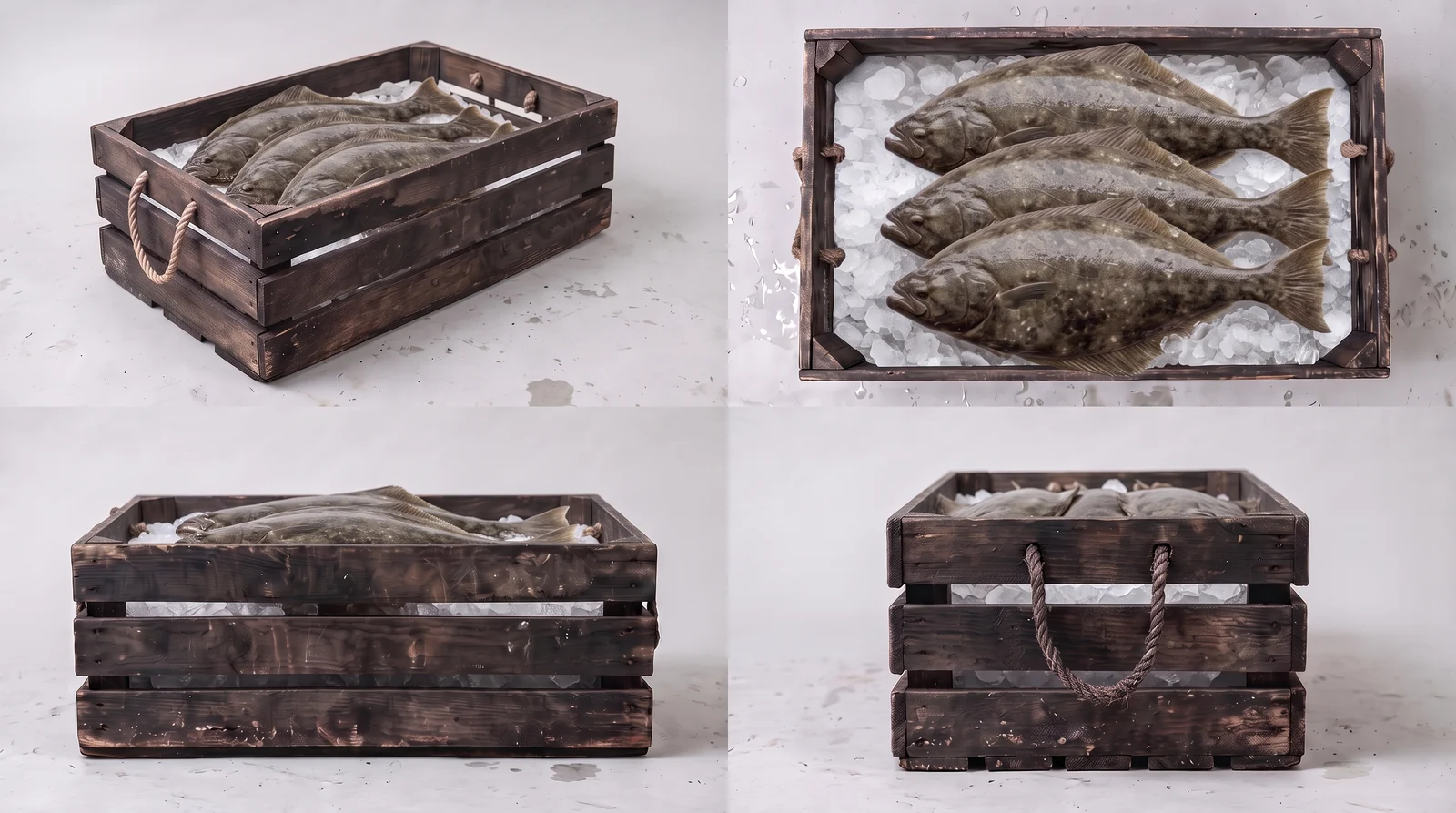
Make a reference sheet of one wooden crate. The crate is exactly one crate from the stack of dark crates on the pier in image 1; image 2 is an enlarged crop of the same stack. Copy its construction exactly: every wall is made of THREE horizontal slats in height, with narrow gaps between the slats; dark, almost black weathered wood; one rope loop handle in the middle of each end wall, as on the stack; no vertical post in the middle of the walls. The same low, wide proportions as on the stack. Do not add slats, do not redesign it, do not lighten the wood.
Show this one crate four times on a plain light grey studio backdrop, in even soft daylight, in a 2x2 grid:
1. top left: three-quarter view, the crate open and empty, a flat lid of the same dark slats leaning against it;
2. top right: straight top-down view into the open crate: crushed half-melted ice and three whole halibut lying side by side, heads to the left: wet olive-brown skin with dark spots, dark glossy eyes, closed mouths; real fish, not plastic;
3. bottom left: view of a long wall, lid on;
4. bottom right: view of an end wall with the rope handle, lid on.
The crate is identical in all four views: three slats in height on every wall. Photorealistic, sharp. No people, no text, no lettering, no captions.
Потом я кладу в ящик трёх палтусов с фотографии из шага 5. Референсов два: лист ящика и палтус. В промте названо, какой вид изменить и что оставить как есть.
Edit image 1. Change only the top right view, the top-down view into the open crate. Replace the ice and the fish in the crate with the ice and the fish from image 2: the crate is filled with the same crushed ice, and on the ice lie three whole halibut exactly like the fish in image 2: the same flat diamond-shaped body, the same matte olive-brown mottled skin, the same fins and tail, the same wet natural look, not glossy. The three fish are the same size, lie along the long side of the crate, heads to the left, tails to the right, partly overlapping like roof tiles, each fish clearly visible: three heads, three tails. They fit inside the crate. Keep the crate itself in this view and the other three views of the sheet exactly as they are. No text.
Последним промтом я открываю ящик на всех четырёх видах: в видео ящики стоят без крышек. Референс один — лист ящика.
Edit image 1. Make the crate open in all four views: remove the lid everywhere, there is no lid anywhere on the sheet. In all four views it is the same open crate filled with crushed ice with the same three halibut lying on the ice, exactly as in the top right view.
Top left: three-quarter view of the open crate, the ice and the three halibut visible inside, nothing leaning against it.
Top right: keep as it is.
Bottom left: the long wall seen from the side, the crate open, the ice and the backs of the fish just visible above the top edge.
Bottom right: the end wall with the rope handle seen from the front, the crate open, the ice just visible above the top edge.
Keep the crate itself exactly as it is: the dark slats, three slats in height, the rope handles, the proportions, the backdrop. No text.
Так же, отдельным промтом, я правлю на листе любую деталь: готовая картинка идёт референсом, а в промте названо, что изменить и что оставить.
Шаг 7. Стекло
Стекло — кадр, с которого видео начинается: тот же причал за сплошь запотевшим стеклом в каплях. С него видеомодель берёт пелену, капли и потёки.
Стекло я делаю правкой локации: загружаю причал без ящиков референсом и прошу показать тот же вид через запотевшее стекло. В промте три требования. Резкость стоит на поверхности стекла. За стеклом ничего не разобрать: остаются холодный серо-синий свет и тёплое пятно лампы. Стекло занимает весь кадр, без рамы и подоконника, как и в видео.
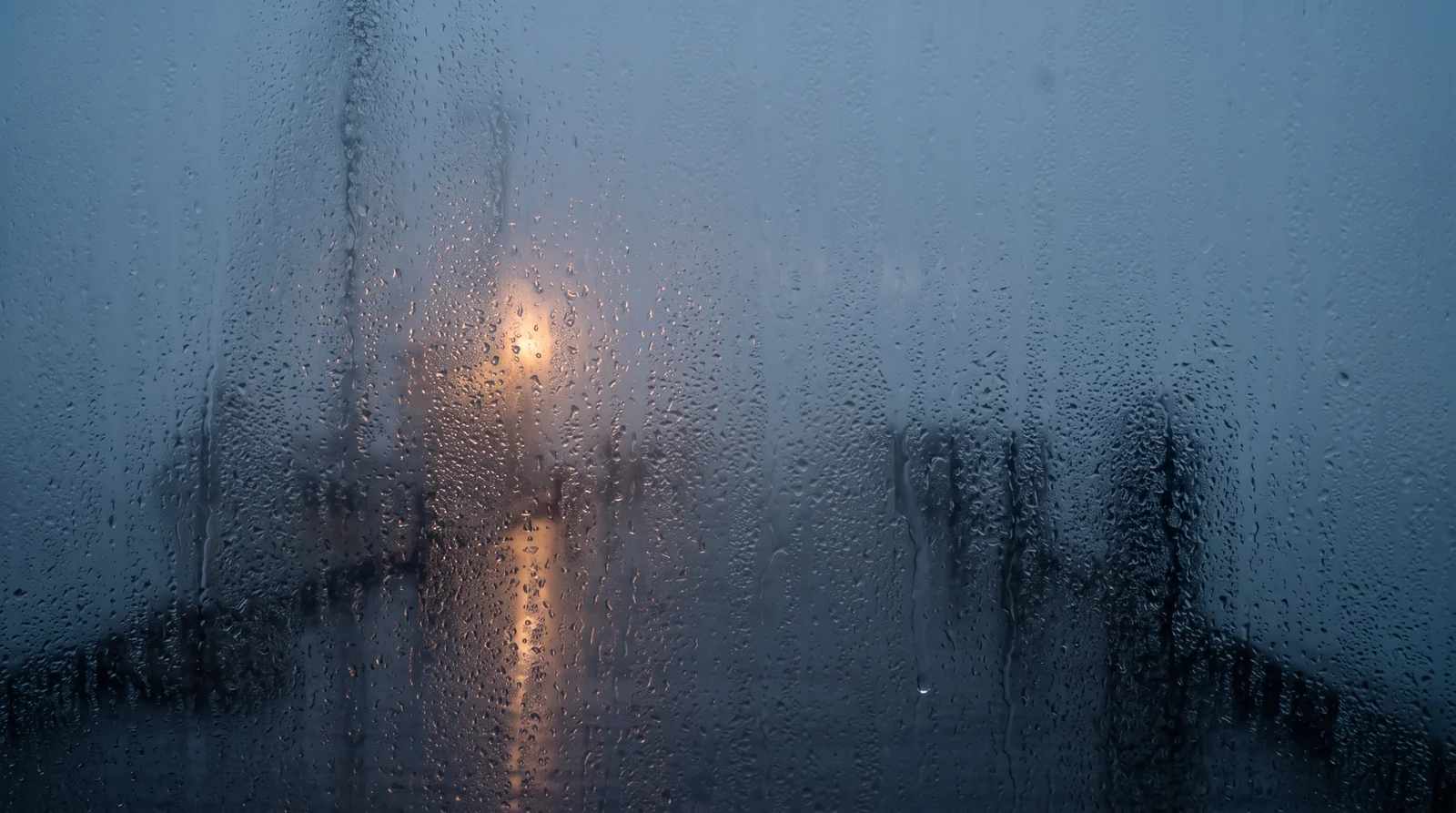
Edit image 1. Show the same view photographed from indoors through a sheet of glass that is completely fogged over. A dense, opaque, milky layer of condensation covers the whole surface of the glass from edge to edge, and on it sit hundreds of drizzle droplets of different sizes and a few trickles running down. The focus is on the surface of the glass.
Nothing behind the glass can be made out: no boat, no mast, no pier, no posts, no rope, no outlines of any kind. Through the fogged glass there is only the cold blue-grey light of the dawn and one dim, shapeless warm glow where the lamp is.
The glass covers the entire picture: there is nothing but glass at all four borders, no frame of any kind, no bars, no sill, no wall, no reflection of a room. No people, no text.
Шаг 8. Рука с тремя пальцами
Рука — отдельный ассет для одного жеста: правая кисть рыбака в перчатке показывает три пальца. С неё видеомодель берёт кисть и положение пальцев в конце счёта.
Референс один — лист рыбака: с него взяты перчатка и рукав штормовки. Положение каждого пальца названо в промте отдельно: указательный, средний и безымянный стоят прямо, большой прижимает мизинец. Число тоже названо прямо: подняты ровно три пальца, всего на кисти пять. Жест, от которого зависит смысл видео, я задаю картинкой, а не только словами, и в промте видео ссылаюсь на неё.
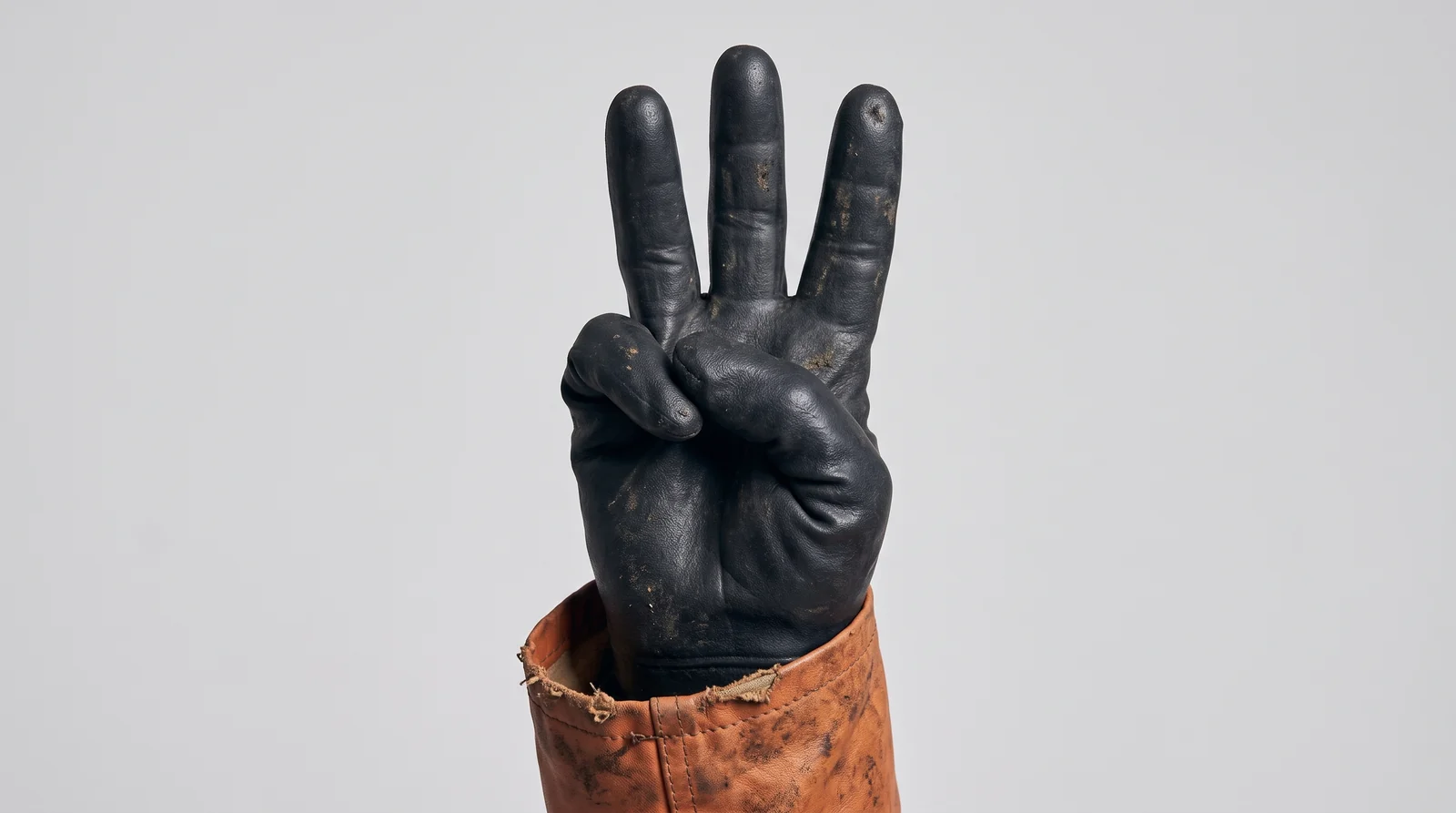
A close-up reference photograph of one hand. It is the right hand of the fisherman from image 1, in the same black rubber work glove, with the cuff of the same orange oilskin sleeve. The hand is raised, palm towards the camera, and shows the number three: the index, middle and ring fingers stand straight and slightly apart; the thumb lies across the palm and holds the little finger down. Exactly three fingers are up, exactly five fingers on the hand. Plain light grey studio backdrop, even soft light, the hand fills most of the picture, sharp. Only one hand, no face, no body, no text.
Шаг 9. Промт для видео
В промте видео описано как один непрерывный дубль на 25 секунд, без слов и музыки. Первые десять с половиной секунд камера стоит за стеклом, потом выходит на причал.
Видео собирается из семи ассетов: локация, два листа персонажей, лист ящика, палтус, стекло и рука идут референсами. В промте они названы по номерам — с image 1 по image 7, — поэтому я загружаю их в том же порядке. У каждого референса сказано, что с него брать, а в конце блока — чего не брать: серый фон, раскладку и студийный свет листов.
Промт разбит на блоки: контекст сцены, формат, люди, два главных правила, условия неверного кадра, референсы, размеры, планировка пространства, действие по времени, игра, камера, оптика, свет и погода, физика и материалы, счёт, звук, запреты и то, что должно держаться до конца. Действие расписано по отрезкам с точностью до полсекунды: это кадры раскадровки из шага 1, разложенные по времени. Движение камеры расписано по времени отдельным блоком.
То, что в видео должно совпасть, названо в начале промта и повторено в конце: три пальца и три рыбы, один и тот же ящик от штабеля до последнего кадра. Размеры ящика даны через тело человека: в длину он на ладонь шире плеч с каждой стороны, в высоту — с предплечье. Официанта нет в кадре первые шестнадцать с половиной секунд, и в промте сказано, где он в это время: стоит слева от камеры и движется вместе с ней.
В блоке «Добавление картинок» я выбираю «Картинки-референсы» и загружаю ассеты в таком порядке: 1) локация, 2) лист рыбака, 3) лист официанта, 4) лист ящика, 5) палтус, 6) стекло, 7) рука с тремя пальцами. Формат 16:9, длительность 25 секунд, звук включён. Затем вставляю промт:
SCENE CONTEXT
We look through glass covered with drizzle and mist at a fishing pier before dawn. THE FISHERMAN wipes the drops off, counts on his fingers up to three, lifts THE CRATE off a stack and hands it to THE WAITER; THE WAITER carries THE CRATE towards us, and the camera looks into it: three fish.

FORMAT
25 seconds. One continuous take. Cuts: zero. Frame 16:9. No speech, no music.
Until 0:10.5 the camera stays behind the glass. From 0:10.5 it goes out onto the pier.

PEOPLE LAW
THERE ARE TWO PEOPLE IN THE PIECE: THE FISHERMAN from image 2 and THE WAITER from image 3. There is no third person anywhere: not on the boat, not in the fog, not in a reflection.

THE TWO MOST IMPORTANT RULES — THEY CANNOT BE BROKEN
1. THE COUNT IS THREE. THE FISHERMAN counts on his fingers exactly up to three. Exactly three fish lie in THE CRATE.
2. ONE AND THE SAME CRATE. The stack on the pier is made of four identical CRATES from image 4. THE FISHERMAN lifts the top CRATE off the stack in front of our eyes, whole. This same CRATE, the same size, he hands to THE WAITER, and this same CRATE THE WAITER carries towards us.

FAIL CONDITIONS
IF THE NUMBER OF FINGERS UP AT THE END OF THE COUNT IS NOT THREE — THE SHOT IS WRONG.
IF THERE ARE TWO OR FOUR FISH — THE SHOT IS WRONG.
IF THE CRATE APPEARS IN HANDS AND WE DID NOT SEE IT LIFTED OFF THE STACK — THE SHOT IS WRONG.
IF THE CRATE IN HANDS IS SMALLER OR BIGGER THAN A CRATE IN THE STACK — THE SHOT IS WRONG.
IF A FRAME AROUND THE GLASS IS VISIBLE — THE SHOT IS WRONG.
IF THE WAITER IS VISIBLE BEFORE 0:16.5 — THE SHOT IS WRONG.
IF ANYTHING OTHER THAN THE OPEN-AIR PIER APPEARS IN THE FRAME — THE SHOT IS WRONG.
IF THE WAITER'S ARMS ARE STRETCHED OUT TO THE SIDES — THE SHOT IS WRONG.
IF THERE IS EVEN ONE CUT OR DISSOLVE — THE SHOT IS WRONG.

ACTIVE REFERENCES
image 1 (the pier) — the location. Take everything: the pier, the boat with its lamp, the posts, the gulls, the coil of rope, the wet planks, the fog and the light. There are no CRATES in it: in the video the stack stands on the planks far off on the left, at the prow of the boat, next to the mooring post.
image 2 (character sheet) — THE FISHERMAN. Take the face, the build and the clothes.
image 3 (character sheet) — THE WAITER. Take the face, the hair, the build and the tuxedo. His hands are bare.
image 4 (crate sheet) — THE CRATE. It is one and the same CRATE in four views, not four CRATES. Take the shape, the dark slats, the rope handles, the ice and the three fish.
image 5 (photo of a halibut) — THE FISH up close. Take the skin, the shape and the wet sheen: all three fish in THE CRATE look like this.
image 6 (the glass) — THE GLASS at the start, fully fogged over. Take the layer of condensation, the droplets, the trickles, and the fact that nothing can be made out through it. There is no frame around the glass, neither in the image nor in the video.
image 7 (the hand) — THE FISHERMAN's right hand at the end of the count: three fingers up. Take only the gloved hand and the position of the fingers; do not take the sleeve.
From the sheets and from image 7 DO NOT take the grey backdrop, the layout or the studio light; from image 5 do not take the framing. Each thing is taken only from its own image.

DIMENSIONS
THE FISHERMAN: 178 cm, stocky, broad in the shoulders. THE WAITER: 182 cm, slim.
THE CRATE: in length one hand's width wider than a grown man's shoulders on each side; in height the same as a forearm from elbow to wrist. Rope handles on the two short sides. With the ice and the fish it weighs about 15 kg. When THE WAITER holds it by the handles, his upper arms hang down along his body, his elbows are held against his sides, THE CRATE is close to his belly.
THE STACK: one column of four CRATES. Its top is level with THE FISHERMAN's elbow. The CRATES are open, without lids; all of them hold ice and fish, seen in the top one.

SPATIAL LAYOUT — take this in first
— At the start the camera stands on our side of the glass, 50 cm from it, the lens 150 cm above the ground.
— The glass fills the whole frame: it is one seamless sheet of glass that runs past all four edges of the picture. There is no frame around it.
— The pier begins right behind the glass and runs straight away from us, as in image 1.
— The stack stands far off on the pier on the left, at the prow of the boat, next to the mooring post.
— At the start THE FISHERMAN stands at the stack on its open-pier side, side-on to us, facing the CRATES. He comes back to this same spot for THE CRATE.
— Until 0:16.5 THE WAITER is out of frame: he stands to the left of the camera and moves together with it.

ACTION TIMING
0:00–0:01 — The glass fills the frame, as in image 6: it is fully fogged over and covered with drizzle — a layer of condensation, hundreds of droplets, a few trickles running down, the focus on them. No frame around the glass is seen: the glass runs past all four edges of the picture. Almost nothing can be made out through the glass: only cold blue-grey light, the shapeless warm glow of the lamp and the dim silhouette of THE FISHERMAN far off at the stack.
0:01–0:04.5 — THE FISHERMAN walks from the stack to the glass at a brisk working pace. Through the fogged glass we see only his silhouette, a dark orange blur with no features, growing larger. He stops one step from the glass, slightly right of the centre of the frame.
0:04.5–0:05.5 — He gently lays his palm in a black rubber glove on the glass from his own side and in one continuous movement wipes the drops and the mist off: he draws the palm in a wide arc without lifting it from the glass. He does not slap or knock on the glass. In the middle a clear oval opens, two thirds of the frame wide; along the edges of the frame the droplets and the mist remain. In the oval THE FISHERMAN and the pier from image 1 behind him are clearly seen for the first time; far off on the left, at the prow of the boat, next to the mooring post, stands the stack of four CRATES. The focus moves to his face.
0:05.5–0:07 — He moves in close to the glass and sets his right hand like a visor above his eyebrows. He narrows his eyes and peers towards us.
0:07–0:10 — He brings his right hand down from his brows and holds it in the air in front of him, at shoulder height. His gaze moves across three points close to the lens, from left to right. He counts to himself: one (he shows one finger, the index) — three (he shows three fingers, as in image 7: the index, middle and ring fingers stand straight, the thumb holds the little finger down). He holds the three fingers for one second. The hand does not touch the glass. The hand does not touch his body. His lips are closed.
0:10–0:10.5 — He lowers the hand and takes one step back; he is seen from the waist up.
0:10.5–0:14.5 — THE FISHERMAN turns his back to us and walks to the stack. We see him from behind all the way: he never leaves the frame and never becomes transparent. The camera starts forward, follows him and passes through the glass: the droplets slide to the edges of the frame, and the glass is left behind. The camera stops two and a half metres from the stack and turns slightly left and down: THE FISHERMAN from the knees to the top of his head and the stack are in the frame. THE FISHERMAN stands at the stack side-on to us, facing the CRATES.
0:14.5–0:16.5 — With both hands he takes hold of the rope handles of the top CRATE and lifts it off the stack whole. All of it is seen from the side: THE CRATE comes off the CRATE below it, his arms tense under the weight. Three CRATES are left in the stack, and the top one of them also holds ice and fish.
0:16.5–0:18.5 — With THE CRATE at his waist, on bent arms, held flat, its base horizontal, he turns and walks towards us. He does not raise THE CRATE to his chest and does not tilt it towards us. The camera moves back by one metre. THIS IS THE FIRST TIME WE SEE THE WAITER: on the left, in the near foreground, the back of his head, his neck and his right shoulder come into the frame, large and out of focus, in the left third of the frame. We look over his shoulder at THE FISHERMAN with THE CRATE.
0:18.5–0:20 — THE FISHERMAN walks up to THE WAITER and hands THE CRATE over whole. THE WAITER stands with his back to us, turned three-quarters, and THE CRATE between them is visible in the frame: THE WAITER takes the rope handles with his bare hands, his shoulders drop a little under the weight. THE FISHERMAN takes his hands away. FROM THIS SECOND THE FISHERMAN DOES NOT LEAVE HIS SPOT until the end of the piece.
0:20–0:22 — THE WAITER turns to us on the spot and walks towards us along the pier at an even pace. THE CRATE is in front of him at his waist, held flat, its base horizontal, his elbows bent and held against his sides. His gaze passes above the camera, ahead along his way. While he turns, the camera pulls back from him by a metre and a half, then keeps pulling back at his walking speed and stays two and a half metres away; he is in the frame from the hips to the top of his head. THE FISHERMAN stands on his spot behind and watches him go; with each of THE WAITER's steps he is smaller in the frame.
0:22–0:25 — THE WAITER slows down and by 0:23 he stops and stands on the pier. As he approaches, from behind the camera a warm flickering light falls on him more and more strongly, as from an open fire behind the camera: amber, coming from waist and chest height, its brightness floating unevenly two or three times a second. He holds THE CRATE the same way, does not tilt it and does not hold it out. The camera stops with him and smoothly, by 0:24.5, comes one metre closer, rises a little above his eyes and tilts down by 25 degrees. At the end THE CRATE fills the lower half of the frame: on crushed ice lie three halibut, as in image 5, heads to the left, and the warm firelight trembles on the ice, on the wet skin of the fish, on THE WAITER's hands and on his white shirt. In the upper half of the frame is his chest: the white shirt, and the black bow tie at the top edge. WE DO NOT SEE THE FIRE ITSELF: only its light. Under THE WAITER's feet and behind him are the same wet blue planks of the pier.

ACTING
THE FISHERMAN is taking an order through the glass: it is his work. He does not play to the viewer: no smile, no wink. Everything is in the eyes: walking up, he looks at the glass; wiping, at his own palm; counting, at three points close to the lens; after that his eyes are on the CRATE, on THE WAITER and on his back as he goes. He stands and walks with a straight back: the handles of the top CRATE are at the height of his waist.
THE WAITER is restrained. He does not look into the lens for a single frame. For him THE CRATE is a load, not goods on show.

CAMERA
0:00–0:10.5 — one position behind the glass, the camera locked off, height 150 cm, with only a barely visible sway.
0:10.5–0:14.5 — a smooth move forward after THE FISHERMAN, through the glass, with a slight turn left and down, onto the stack; it stops two and a half metres from the stack.
0:14.5–0:16.5 — it rests two and a half metres from the stack.
0:16.5–0:18.5 — a move back by one metre, to behind THE WAITER's shoulder.
0:18.5–0:20 — it rests behind his shoulder.
0:20–0:22 — a pull-back along the pier: by a metre and a half while THE WAITER turns, then at his walking speed.
0:22–0:25 — a stop; then a smooth move one metre closer, a rise a little above his eyes, a tilt down by 25 degrees.
The moves flow into one another, without jerks. The camera does not fly around the people or THE CRATE and does not look straight down into THE CRATE.

OPTICS
One lens for the whole take: moderately wide, a horizontal field of view of about 60 degrees, no distortion, no zoom. Focus: until 0:05.5 on the droplets, then on THE FISHERMAN, from 0:20 on THE WAITER, at the end on the fish. Fine film grain.

LIGHT AND WEATHER
As in image 1: the blue hour before dawn, even cold light with no sun; the only warm light on the pier is the lamp on the wheelhouse of the boat and the light inside the wheelhouse, with a long amber reflection across the wet planks; far away, the light of a lighthouse. Fog, drizzle, every surface wet. A light steam shows at THE FISHERMAN's mouth now and then. He does not breathe out on purpose and does not breathe on the glass.
Before 0:22 no warm light falls on THE WAITER. From 0:22 the light of an open fire rises from behind the camera: warm, from amber to orange, coming from waist and chest height. It is alive: the brightness floats unevenly two or three times a second, with no sharp flashes. The pier behind THE WAITER stays blue and steady.

PHYSICS AND MATERIALS
THE CRATE is heavy: THE FISHERMAN's arms tense as it comes off the stack; at the handover it sags for a moment in THE WAITER's hands. The steps are real: the weight moves from foot to foot. Five fingers on each hand. THE FISHERMAN wipes the glass once and does not touch it again.
The wood of the CRATES is dark and wet. The oilskin is stiff rubberised cloth, wet. The tuxedo is matt black wool with satin lapels. The ice is crushed and half-melted. The fish are wet, with a living wet sheen, as in image 5; not plastic and not varnished. The people's skin is real, with pores.

COUNT
One FISHERMAN, one WAITER, one boat. Until 0:14.5 there are four CRATES in the stack; after 0:16.5 there are three CRATES in the stack and one in hands. Three fingers, three fish. Nobody freezes: in every stretch the droplets, the fog and the breathing are moving.

SOUND
Noises only, no music and no speech. The sound is heard from where the camera stands. No gurgling sounds and no bubbling sounds.
Until 0:10.5, from behind the glass: drizzle on the glass, close; everything outside is muffled — the steps of rubber boots on wet planks, the sea, one distant foghorn; the soft wet squeak of the glove on the glass.
From 0:10.5, on the pier: the muffling lifts in half a second; wind in the rigging, THE FISHERMAN's steps, the creak of the rope handles and the rustle of ice as he lifts THE CRATE; at the handover the handles creak once more; THE WAITER's steps are a hard leather sole.
From 0:22: the steps fall silent, the pier falls back and grows quieter; behind the camera a fire crackles quietly.

BANS
Before 0:10.5 the camera does not go beyond the glass. There is no reverse angle.
The glass does not open and does not break; there is no frame around it.
THE CRATE does not appear from behind a back, from the edge of the frame or out of the air. THE FISHERMAN does not take two CRATES, does not take half a CRATE and does not pull a tray out of a CRATE.
The CRATES have no lids and no lettering. The fish are not taken out.
THE WAITER does not show THE CRATE to the viewer, does not tilt it and does not look into the lens. He wears no gloves.
After the handover THE FISHERMAN does not follow THE WAITER.
The whole video is shot on the pier under the open sky: around us there is only the pier, the boat, the water and the fog. We do not see the fire: no flame, no candles; only its light speaks of it.
THE WAITER is on the pier the whole time and walks along the pier. The camera tracks backwards along the pier in front of him and never leaves the pier.
After the camera has passed through the glass there are no droplets and no haze in front of the lens.
No cuts, no dissolves, no fades, no flashes, no slow motion, no speed-up, no freeze frames.
No text anywhere: no lettering on the CRATES or on the boat, no signs, no subtitles, no logos, no watermarks. Nobody fades away or jumps from one place to another.
No drawn or game-engine look, no plastic skin.

WHAT MUST HOLD
One FISHERMAN and one WAITER, in the same clothes and with the same faces.
All the CRATES are identical, as in image 4; THE CRATE is one and the same from the stack to the last frame.
Three unfolded fingers at the end of the count and three fish at the end of the video.
The boat, the lamp, the posts and the stack stay in their places.
Перед генерацией в 720p я делаю тест в 480p с теми же ассетами. В тесте я смотрю, что рыбак, официант, причал и ящик взяты с ассетов и что действие идёт по отрезкам из промта.
Шаг 10. Музыка
Музыка — инструментальный трек, который я накладываю на готовое видео. Seedance делает звук вместе с видео: шаги, море, скрип ручек. Музыки в этом звуке нет: в промте видео она запрещена.
Трек я делаю в Suno по одному промту, в инструментальном режиме, без голоса. В промте сказано, для какой сцены музыка, какие инструменты играют и какой у неё характер: медленная, холодная, без ударных. Последняя фраза задаёт конец: гармония разрешается в тёплый аккорд, как свет огня в последнем кадре. Строка Exclude styles перечисляет, чего в музыке быть не должно. Длительность трека 28 секунд, чуть больше видео.
Slow cinematic underscore for a short film scene on a foggy fishing pier before dawn. Low sustained strings and soft felt piano, sparse single notes, a lot of air between them. Cold, calm, patient, a little mysterious. No drums, no percussion, no beat. Near the end the harmony resolves into a warm major chord with a gentle swell, like firelight. Minimal, intimate modern film score.

Exclude styles: drums, percussion, beat, vocals, choir, synth lead, electric guitar, upbeat, pop
На один запрос Suno выдаёт два трека, я беру один. Музыка идёт с первой секунды видео и плавно уходит в конце. Звук самого видео я делаю в два раза тише: шумы причала остаются под музыкой. Наложение я сделал через агента Claude Code.
Результат
Действие идёт в том же порядке, что в промте, и близко к размеченным отрезкам.
Первые десять секунд камера стоит за стеклом: рыбак подходит оранжевым пятном, протирает стекло ладонью, ставит ладонь козырьком над глазами и показывает число на пальцах. На причале он снимает верхний ящик со штабеля и отдаёт официанту. Официант идёт с ящиком на камеру, и в последнем кадре на льду лежат три палтуса, а на ящик и руки ложится тёплый свет. Рыбак, официант, причал, ящик и рыба взяты с ассетов.
В готовом видео рыбак показывает два пальца, а палтусов в ящике три. Модель нестабильно ведёт себя с количеством пальцев: генерирует то три пальца, то два, то один. Я оставил так: рыбак насчитал двоих, а третью рыбу положил от себя.
Чтобы сделать по этому гайду свою рекламу, меняются идея и раскадровка в шаге 1, персонажи в шагах 2 и 3, локация в шаге 4, товар в шагах 5 и 6 и действие по времени в промте видео. Порядок шагов и блоки промта остаются те же.